Course Content
Module 1: Introduction to Large Language Models (LLMs) in Law
What LLMs Are (and Aren’t): A Lawyer‑Friendly Mental Model Legal Use Cases & Risk Tiers
0/5
Module 2: Fundamentals of Effective Prompt Design for Legal Tasks
The ICI Framework: Intent + Context + Instruction Advanced Prompt Techniques for Legal Work Prompt Debugging: Lost Middle, Ambiguity, and Token Hygiene
0/5
Module 3: Verifying and Validating AI-Generated Legal Content
Validation Mindset: Why Verification Is Non‑Negotiable Hallucinations in Legal Content: Red Flags & Fixes Bias, Relevance, and Fit: Quality Control Beyond Accuracy
0/5
Module 4: Ethical Considerations and Responsible AI Use in Law
Confidentiality & Data Handling: What You Can Paste Into AI Competence, Supervision, and Accountability with AI Build Your Firm AI Policy Template
0/5
Module 5: Building a Personal Prompt Library and Future Trends
Designing a Personal Prompt Library Future Trends: Specialized Legal Models, RAG, and Agents Build 10 High-Value Prompts You’ll Actually Reuse Final Assessment: Applied Prompt Engineering Scenario
0/5
Prompt Engineering for Legal Applications

Validation Mindset: Why Verification Is Non‑Negotiable

In legal practice, “plausible” is not good enough. AI output must be verified against authoritative sources before use in advice, filings, or client communication.
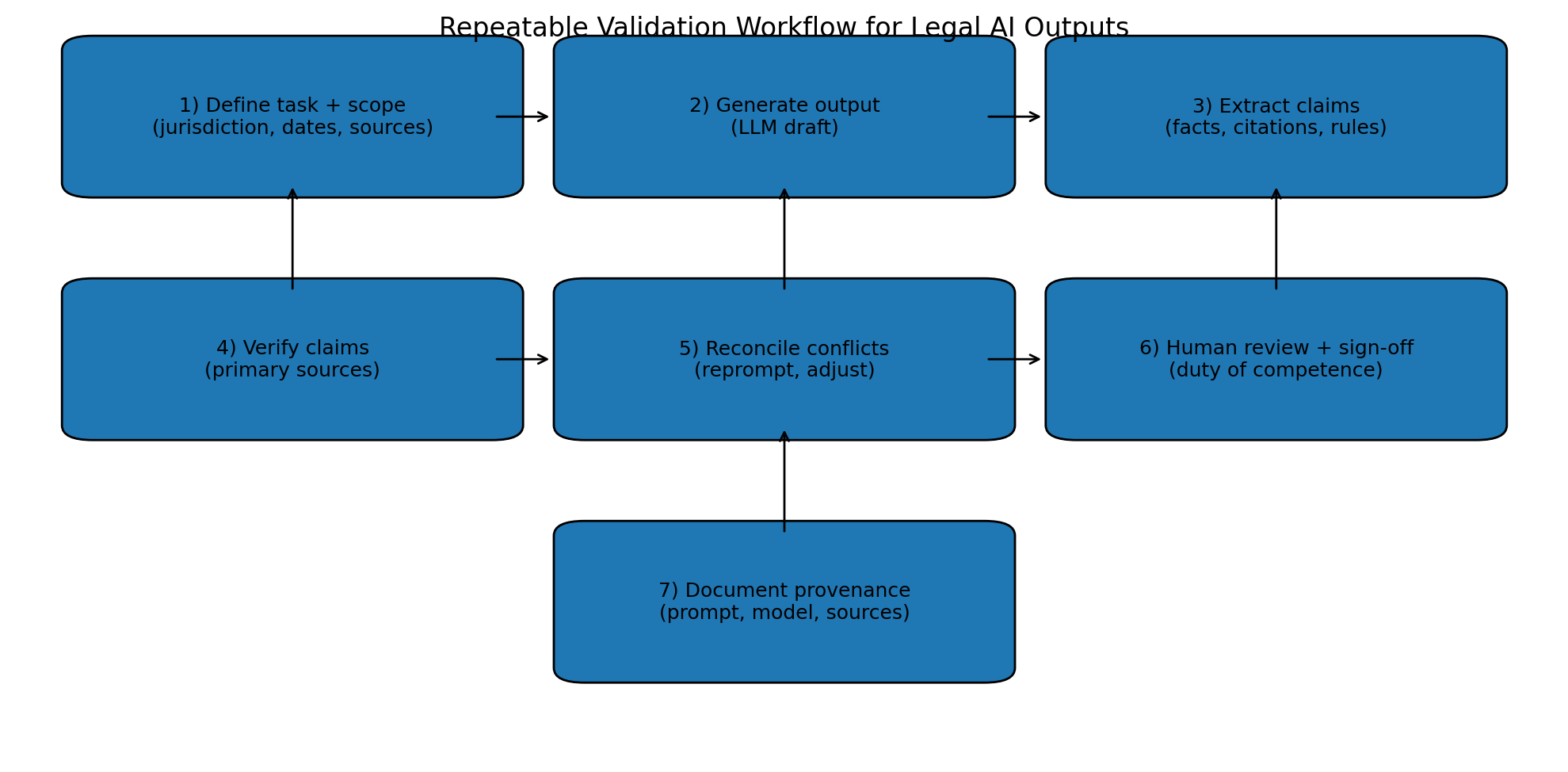
A defensible workflow: generate → verify → revise → document checks.

Key takeaways

  • Verification is mandatory for anything beyond low-stakes drafting.
  • Treat AI output like a junior draft: helpful, not authoritative.
  • Document your validation steps for defensibility.

Your baseline rule

Never rely on an AI-generated citation, quote, or factual claim without checking it. Verification is faster than fixing sanctions.

A defensible workflow

  1. Generate a draft with the model.
  2. Extract every factual claim/citation into a checklist.
  3. Verify using primary sources (cases/statutes) and trusted secondary sources.
  4. Revise the draft with corrected citations and tightened reasoning.
  5. Keep a record of what you checked (for defensibility).

When to stop using the model

If the model repeatedly invents citations, refuses to follow constraints, or cannot stay within a jurisdiction, stop and switch to traditional research tools or a retrieval system that uses a vetted database.

Reference example

Example of why verification matters: Mata v. Avianca (S.D.N.Y. June 22, 2023).