Course Content
Module 1: Introduction to Large Language Models (LLMs) in Law
What LLMs Are (and Aren’t): A Lawyer‑Friendly Mental Model Legal Use Cases & Risk Tiers
0/5
Module 2: Fundamentals of Effective Prompt Design for Legal Tasks
The ICI Framework: Intent + Context + Instruction Advanced Prompt Techniques for Legal Work Prompt Debugging: Lost Middle, Ambiguity, and Token Hygiene
0/5
Module 3: Verifying and Validating AI-Generated Legal Content
Validation Mindset: Why Verification Is Non‑Negotiable Hallucinations in Legal Content: Red Flags & Fixes Bias, Relevance, and Fit: Quality Control Beyond Accuracy
0/5
Module 4: Ethical Considerations and Responsible AI Use in Law
Confidentiality & Data Handling: What You Can Paste Into AI Competence, Supervision, and Accountability with AI Build Your Firm AI Policy Template
0/5
Module 5: Building a Personal Prompt Library and Future Trends
Designing a Personal Prompt Library Future Trends: Specialized Legal Models, RAG, and Agents Build 10 High-Value Prompts You’ll Actually Reuse Final Assessment: Applied Prompt Engineering Scenario
0/5
Prompt Engineering for Legal Applications

Build Your Firm AI Policy Template

A short, clear policy is better than a long policy nobody follows. Start with a one-page skeleton and iterate.
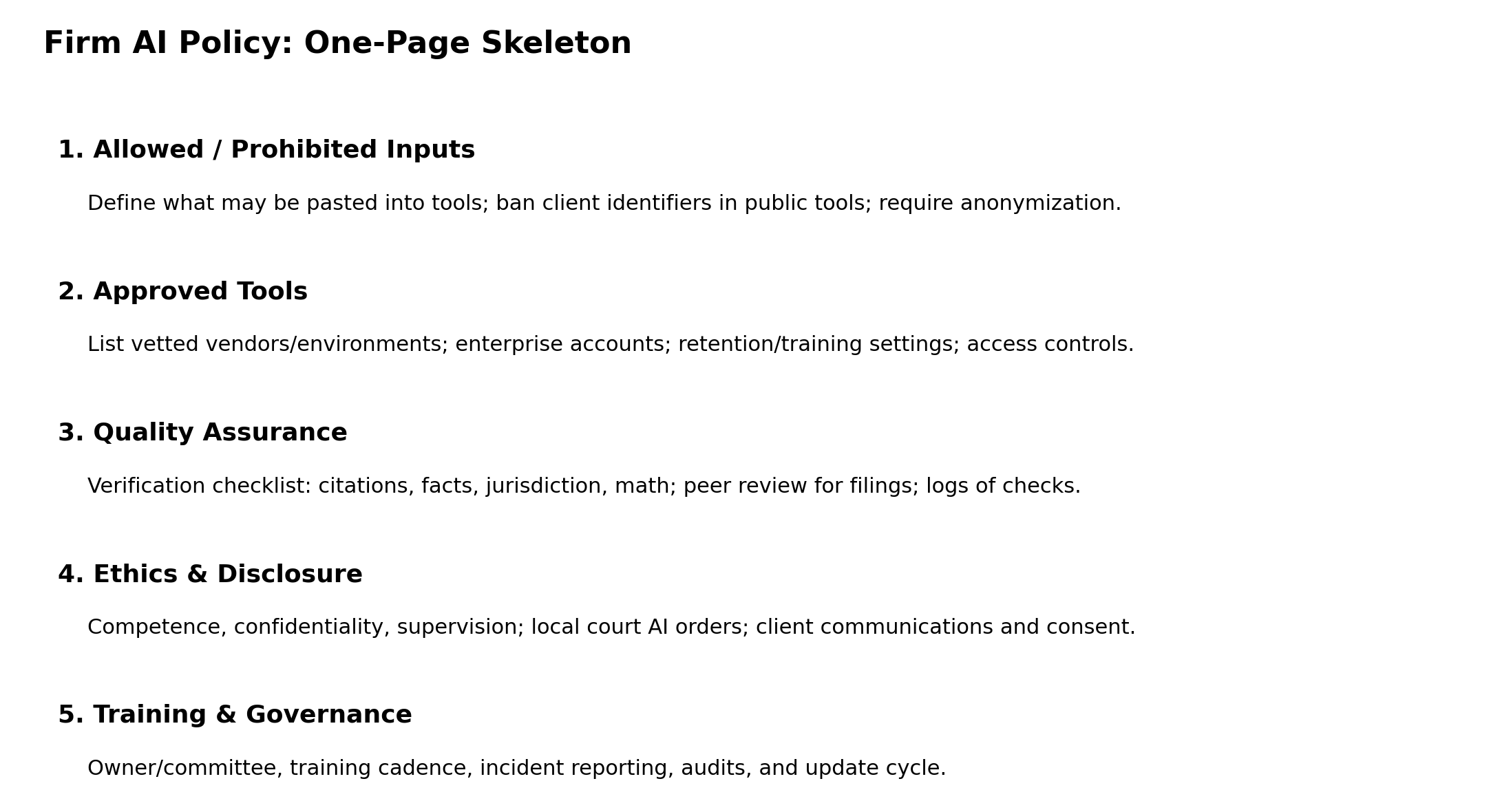
A practical one-page policy outline you can adapt.

Policy minimum viable product (MVP)

  1. Allowed/prohibited inputs
  2. Approved tools and access controls
  3. Verification and review requirements
  4. Client communication/disclosure expectations
  5. Training + incident reporting

Implementation tip

Pair the policy with short training and a shared prompt library. Most AI risk comes from inconsistent workflows, not the technology itself.