
Confidentiality, Privilege & Data Privacy: Safe Inputs
Confidentiality is the fastest way to create irreversible harm with AI. Once sensitive data leaves your environment, you may not be able to “unring the bell.” The goal is to treat AI use like any other third‑party processing: apply safeguards, reduce exposure, and document decisions.
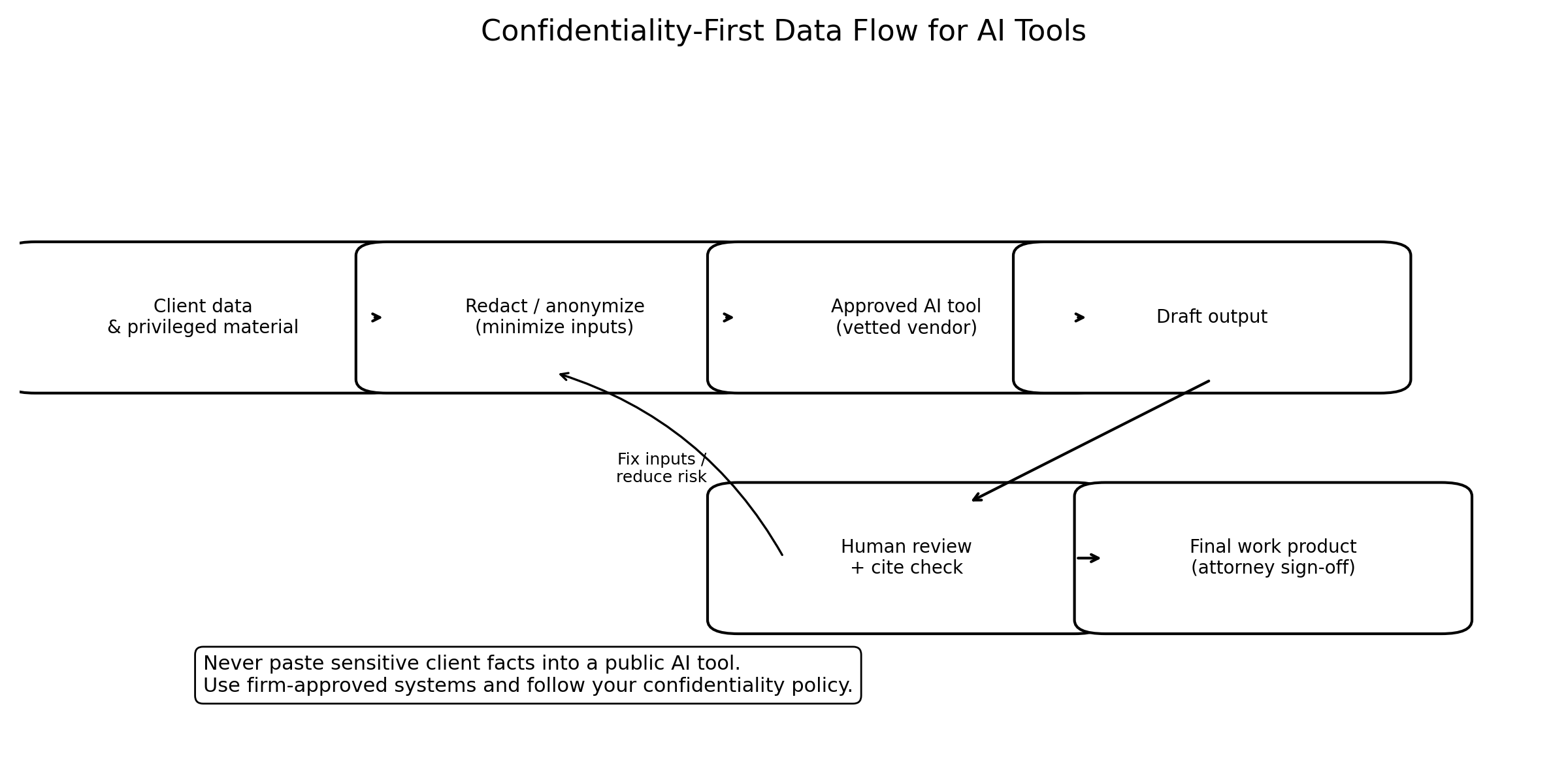
Input safety rules (practical defaults)
- Minimize: share the smallest amount of text needed to do the task.
- De‑identify: remove names, account numbers, addresses, and unique identifiers whenever feasible.
- Avoid privileged strategy: do not paste mental impressions, litigation strategy, or settlement posture into tools that are not explicitly approved for that use.
- Use approved tools: prefer enterprise or “no training/no retention” configurations when available.
- Control access: limit tool use to trained staff; require strong authentication.
What counts as “confidential” in practice?
Confidential information can include anything relating to the representation of a client—even if it does not “look” sensitive. In AI workflows, this often includes:
- Client identities and relationships
- Non‑public facts, timelines, and internal communications
- Strategy, impressions, and legal theories
- Draft filings and negotiation positions
- Regulated data (health, financial, biometric, minors)
Tool categories (and why they matter)
| Tool type | Typical risk | Good for |
|---|---|---|
| Public chat tools | High (retention/training/unknown controls) | Non-sensitive drafting and brainstorming only |
| Enterprise AI tools | Lower (contracted controls, admin settings) | Internal workflows with controlled inputs |
| On‑prem / private models | Lower (if secured properly) | High-sensitivity use cases with strong governance |
Safe input checklist (copy/paste)
- ☐ Tool is approved for this data type
- ☐ Client identifiers removed or minimized
- ☐ Privileged strategy excluded unless expressly approved
- ☐ Output will be stored in a secure location
- ☐ Audit trail recorded (who, what, why, and verification)
Practice tip: If you would not paste it into an email to a vendor without a data processing agreement, do not paste it into an AI tool.