Course Content
Module 1: Introduction to Large Language Models (LLMs) in Law
What LLMs Are (and Aren’t): A Lawyer‑Friendly Mental Model Legal Use Cases & Risk Tiers
0/5
Module 2: Fundamentals of Effective Prompt Design for Legal Tasks
The ICI Framework: Intent + Context + Instruction Advanced Prompt Techniques for Legal Work Prompt Debugging: Lost Middle, Ambiguity, and Token Hygiene
0/5
Module 3: Verifying and Validating AI-Generated Legal Content
Validation Mindset: Why Verification Is Non‑Negotiable Hallucinations in Legal Content: Red Flags & Fixes Bias, Relevance, and Fit: Quality Control Beyond Accuracy
0/5
Module 4: Ethical Considerations and Responsible AI Use in Law
Confidentiality & Data Handling: What You Can Paste Into AI Competence, Supervision, and Accountability with AI Build Your Firm AI Policy Template
0/5
Module 5: Building a Personal Prompt Library and Future Trends
Designing a Personal Prompt Library Future Trends: Specialized Legal Models, RAG, and Agents Build 10 High-Value Prompts You’ll Actually Reuse Final Assessment: Applied Prompt Engineering Scenario
0/5
Prompt Engineering for Legal Applications

Designing a Personal Prompt Library

The fastest way to improve AI outcomes over time is to keep what works. A prompt library is your reusable asset: templates, variants, notes, and version history.
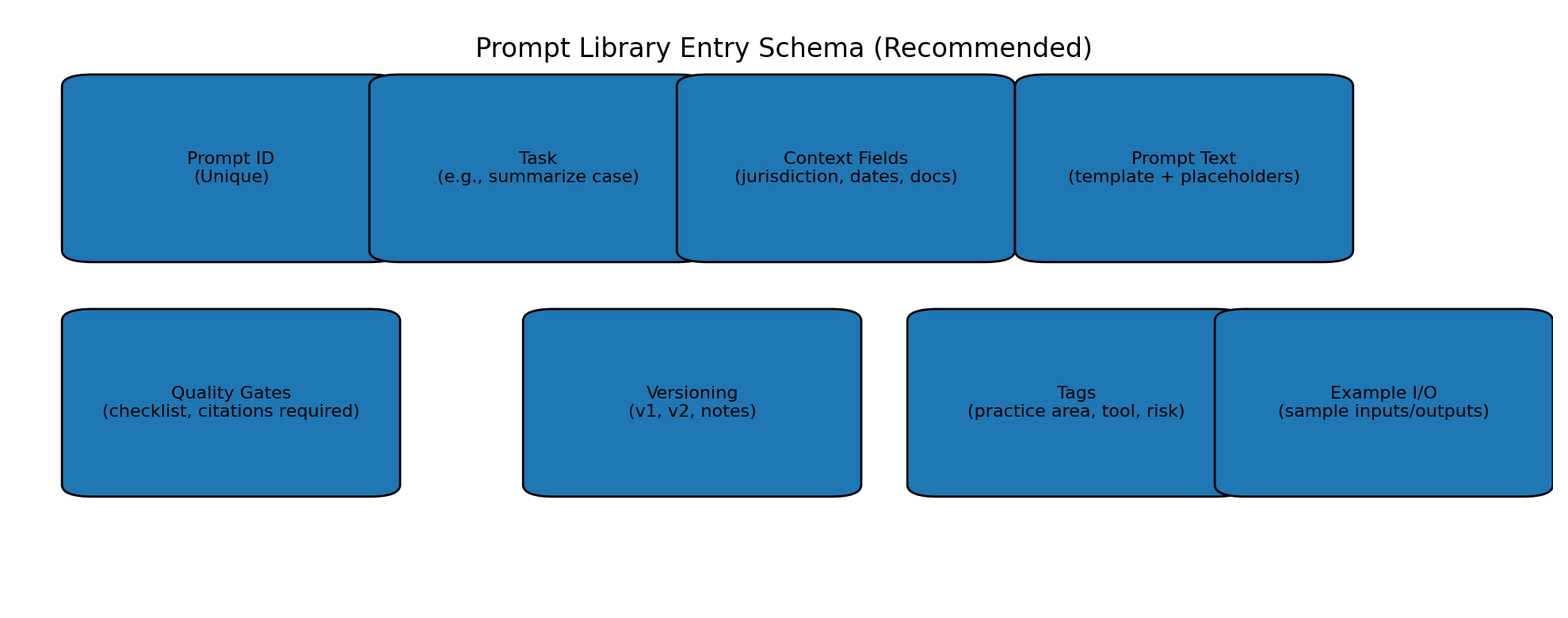
A simple structure: category → template → examples → notes → versioning.

What to store for each prompt

  • Purpose (task + jurisdiction)
  • Prompt text (template with placeholders)
  • Example input and ideal output
  • Known pitfalls and mitigation steps
  • Version history (what changed and why)

How to organize

Organize by task (research, drafting, review, client comms) rather than by model. Models change; workflows persist.

Make it a team asset

Shared prompt libraries improve consistency and reduce risk. Pair prompts with verification checklists and approved tool guidance.