Course Content
Module 1: Introduction to Large Language Models (LLMs) in Law
What LLMs Are (and Aren’t): A Lawyer‑Friendly Mental Model Legal Use Cases & Risk Tiers
0/5
Module 2: Fundamentals of Effective Prompt Design for Legal Tasks
The ICI Framework: Intent + Context + Instruction Advanced Prompt Techniques for Legal Work Prompt Debugging: Lost Middle, Ambiguity, and Token Hygiene
0/5
Module 3: Verifying and Validating AI-Generated Legal Content
Validation Mindset: Why Verification Is Non‑Negotiable Hallucinations in Legal Content: Red Flags & Fixes Bias, Relevance, and Fit: Quality Control Beyond Accuracy
0/5
Module 4: Ethical Considerations and Responsible AI Use in Law
Confidentiality & Data Handling: What You Can Paste Into AI Competence, Supervision, and Accountability with AI Build Your Firm AI Policy Template
0/5
Module 5: Building a Personal Prompt Library and Future Trends
Designing a Personal Prompt Library Future Trends: Specialized Legal Models, RAG, and Agents Build 10 High-Value Prompts You’ll Actually Reuse Final Assessment: Applied Prompt Engineering Scenario
0/5
Prompt Engineering for Legal Applications

Hallucinations in Legal Content: Red Flags & Fixes

Hallucinations are confident-sounding fabrications. Legal prompting should reduce the chance of hallucination and make hallucinations easier to detect.
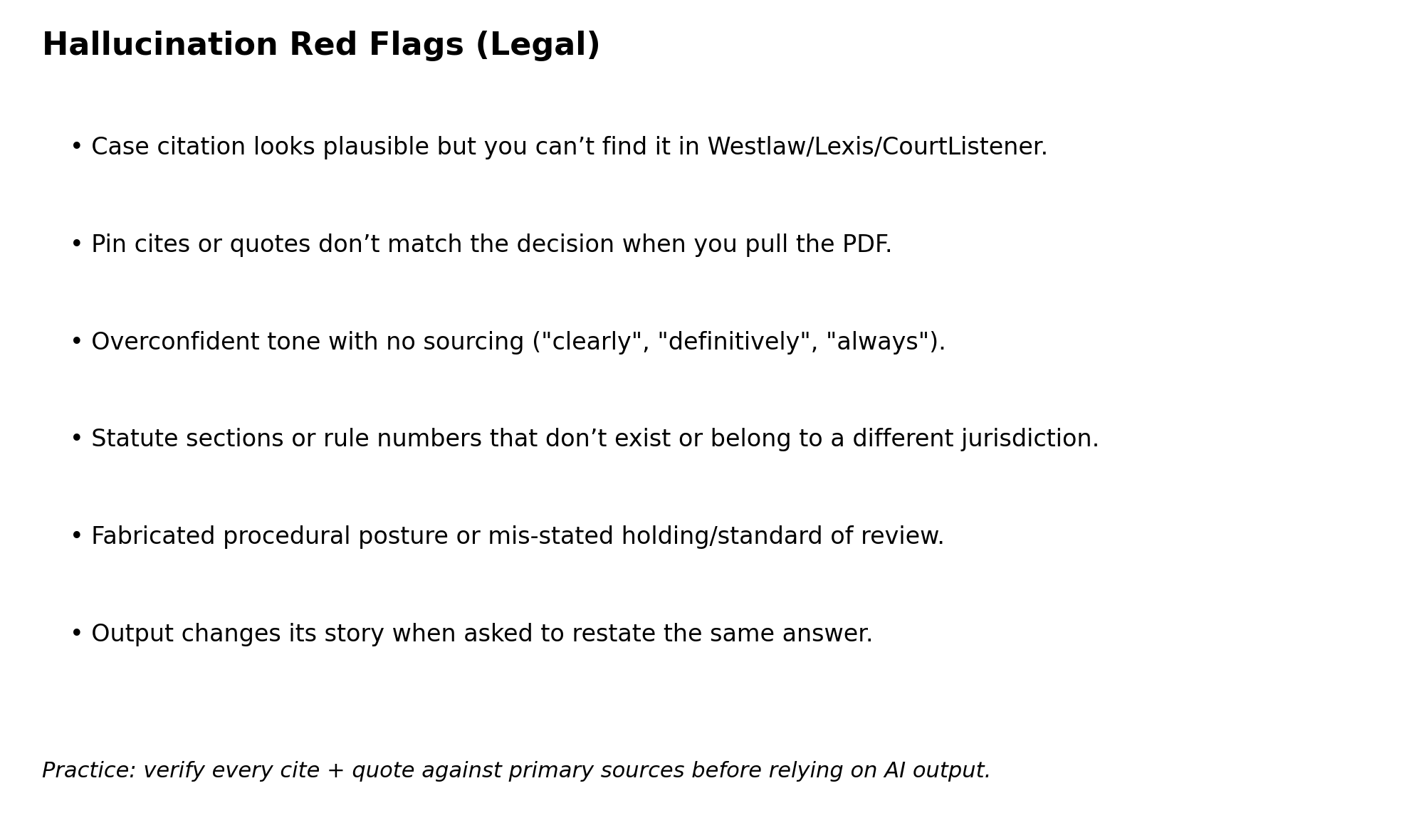
Common signs that a legal AI output may be fabricated or unreliable.

How to reduce hallucinations up front

  • Tell the model to use only provided text (for summaries/extractions).
  • Require it to label assumptions and uncertainties.
  • Ask for citations only when you provide a source set.
  • Use retrieval (RAG) or a legal database workflow when possible.

How to detect hallucinations

Use the red flags chart above, and always spot-check against primary sources. If a case cannot be found, treat it as fabricated until proven otherwise.

A “verify-first” prompt pattern

List all citations and quotations you used. For each, include: source name, pinpoint cite, and a short quote.
If you are not sure, write: "UNCERTAIN" and do not guess.